
No Lakes? No Problem
By - Harry Bulkeley
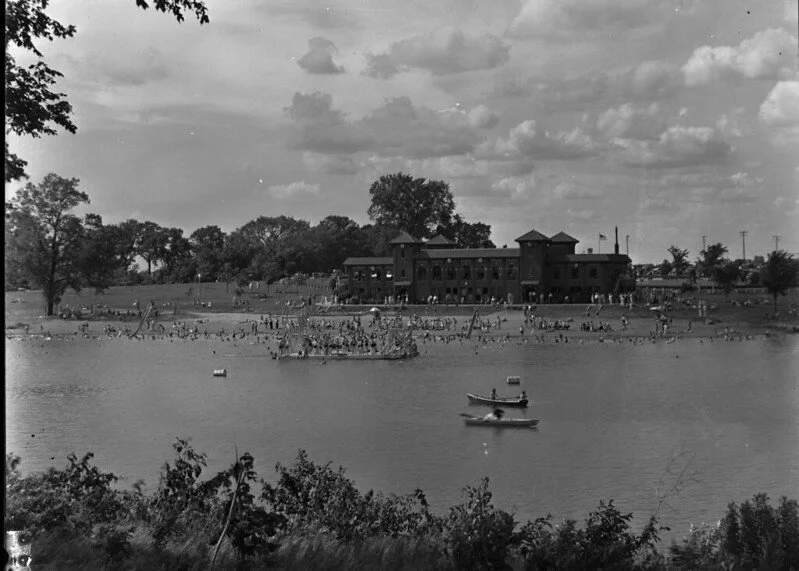
People gathered at the Lake Storey pavilion and beach, circa 1937.
Minnesota folks are lucky (about some things, anyway). Their license plates proclaim theirs is the Land of 10000 Lakes. Actually, I'm told there are over 11, 842 lakes (maybe 11,843?). The one thing we all know is that those lakes were created when Paul Bunyan and Babe, his blue ox, tramped all over the state and left hoof prints and holes from his walking stick.
Mr. Bunyan never came to Forgottonia. Instead, we had Gary Glacier and his Frozen Ice Scraper. Instead of leaving lots of lakes, he left lots of flat. Oh, sure, there are cricks and sloughs and such, but there aren't many real lakes south of Lake Michigan.
So, what are we supposed to do if we want lakefront property or a water hazard on our golf course? Make a lake, of course. And that's just what we started to do about a century ago. These days, "conservation" means returning the land to its natural state, but back then, it meant creating our own vision of nature.
There's a lot of water flowing across our prairies, so all we had to do was dam it up and wait a few months. Voila! A new lake!
The first lakes had a practical application. Steam locomotives needed steam to go, and they needed water to make steam. In the late 19th and early 20th century, in the days before the EPA and similar noodges, the railroads just bought some land, built a dam, and started pumping water out of their lake. Lake Storey and Lake Bracken near Galesburg both began that way. They're even named after Big Wigs in the AT&SF and the CB&Q railroads.
Before long, they became recreation centers for the folks.
Country clubs were all the rage in the Teens and Twenties. Ordinary folks took up golf and needed some water hazards to spoil their fun. Once again, a low spot with a creek could be turned into a body of muddy water without much trouble. The locals would don their Plus 4s and argyle vests, grab their wooden clubs, and set off in search of nature. South of Abingdon, there was a lake created for the very prestigious Abingdon Country Club. In my lifetime, it has been filled in, dug out, filled in, and dug out again. Ah, conservation!
People started building modest summer cabins around the lakes. My grandfather moved a chicken coop out to Lake Bracken as a place for his six kids to get out of grandma's hair for the summer. Decades later, the place still smelled like chickens.
As always happens, cabins turned into houses, and Lake Wee-Ma-Tuk and Lake Warren were created so folks could permanently live next to their favorite fishing hole.
Over fifty years ago, one of the biggest water projects in the area was started near Williamsfield. Oak Run is a development of expensive houses around a 600-acre Spoon Lake. Swimming pools, big ski boats, golf courses, tennis courts, and restaurants make it possible to be out in the country without realizing it.
Lakes have been made for other purposes. Clinton Lake was created in the '70s as a cooling source for the Clinton Nuclear Generating Station. Welp, we have to have electricity, so I guess a few three-eyed fish that glow in the dark are a small price to pay?
The word "conservation" suggests conserving something in nature. But it was also a means of creating a pleasant setting, which was designed to imitate nature or for more mundane reasons. Either way, they are calm, comfortable places to spend a summer afternoon.