
THE FABRIC OF FORGOTTONIA
After 24 editions, two years, and over one million newspapers, The Forgottonia Times says goodbye to the communities that inspired it.
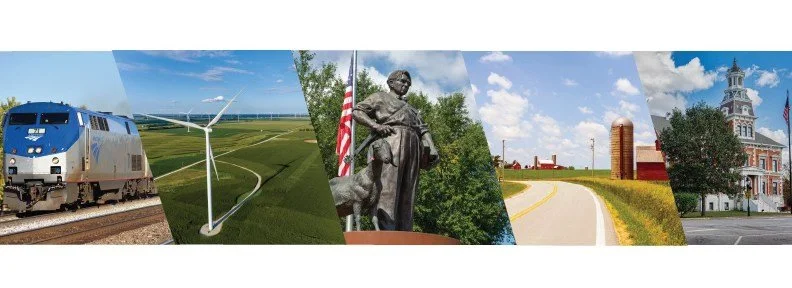
By - Josiah Chatterton, Founder - The Forgottonia Times
When we printed the first edition of The Forgottonia Times in July of 2024, we did not know exactly where it would lead. We did not know how many papers we would print, how many stories we would tell, or how many people across Forgottonia would welcome us into their homes, businesses, schools, churches, farms, festivals, and lives.
What we did know was this: we believed this region deserved better.
We believed west-central Illinois deserved journalism with passion behind it. We believed the communities of Forgottonia deserved storytelling that treated them as something more than a collection of headlines. We believed there were still extraordinary people here doing extraordinary things, even if the rest of the world often overlooked them. Most importantly, we believed this place was worth caring about.
That belief became The Forgottonia Times.
Over the past two years, we published 24 editions and distributed one million free newspapers across Knox, McDonough, Fulton, and Warren counties. Those papers carried stories about veterans, teachers, farmers, artists, entrepreneurs, historians, students, conservationists, small businesses, churches, nonprofits, old buildings, forgotten places, and people quietly making their communities better every single day.
The Forgottonia Times was never really about newspapers. It was about pride of place.
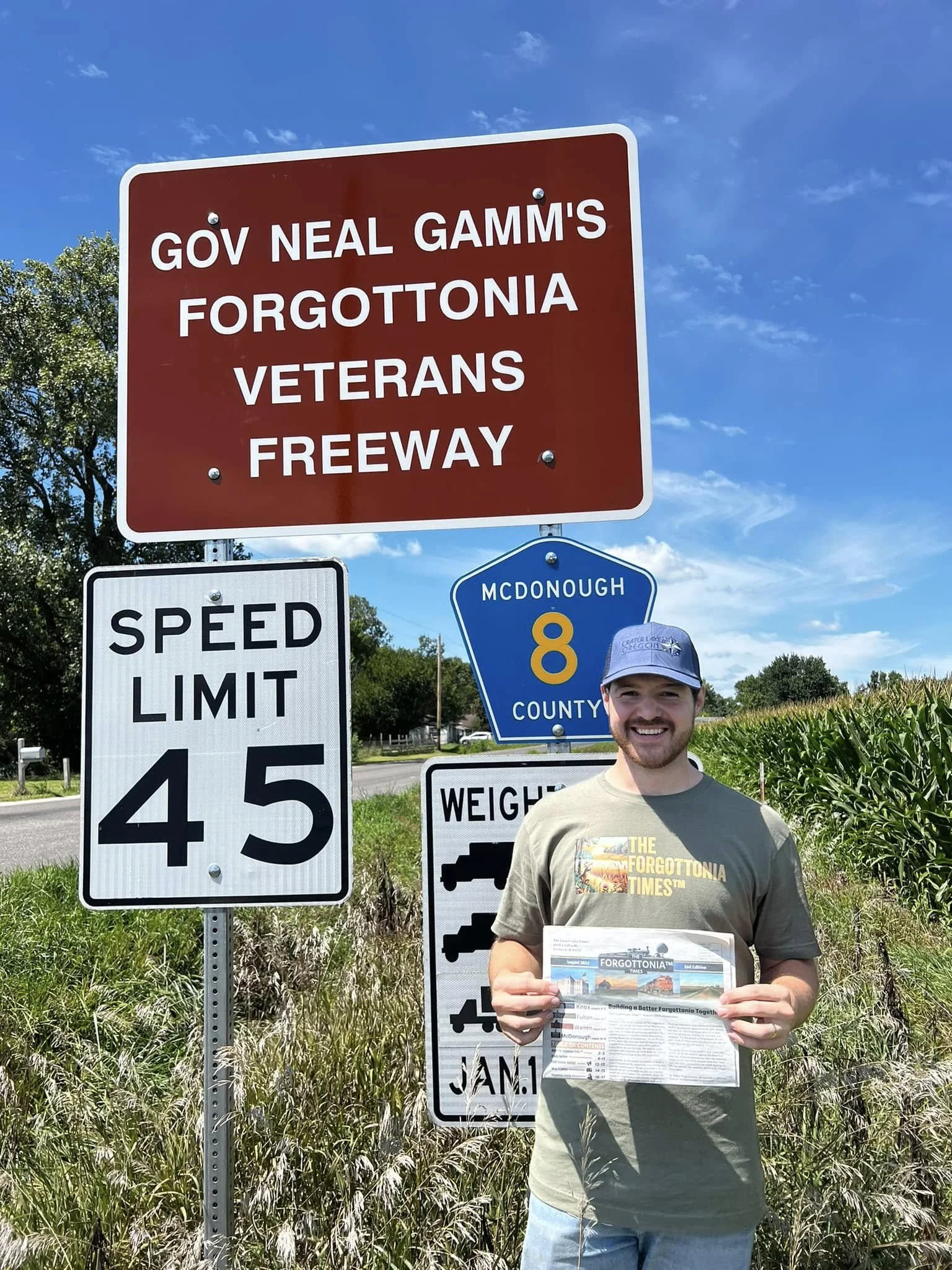
Josiah in the "capitol” of Forgottonia, Fandon, IL.
From the beginning, we wanted this paper to feel different. We wanted people to open it and immediately feel that somebody cared. We wanted it to feel thoughtful, artistic, and real. We wanted readers to feel the same sense of wonder and pride that we felt growing up in these small towns.
Too often, places like Forgottonia are spoken about as if they are empty spaces between larger cities. Too often, the people here are underestimated. Rural communities are frequently reduced to stereotypes and statistics. We rejected that from the beginning because it simply was not true.
What we found instead were communities filled with truly remarkable people. These were people who, despite difficult circumstances and limited opportunities, continued to build meaningful lives in places that did not always make success easy. While many may never achieve what the world traditionally defines as greatness, they developed qualities and an identity that is great in a far more enduring sense. These people are steeped in resilience, faith, craftsmanship, humor, generosity, and grit. This is the fabric of rural America — people who quietly give everything they have to places most of the world ignores.
Some of our favorite stories reflected that spirit perfectly. Stories like the Salvation Army Gym, which donates top-level strength coaching for the price of helping out at the food pantry. Or the old Ball Brothers Carriage Company building that has a million stories to tell. Stories about the Bistro 101 in Canton, where fresh local ingredients and craftsmanship created something exceptional in a place many people would never expect to find it. Stories about conservation, restoration, history, homesteading, music, local businesses, and the subtle beauty woven throughout this region.
Those stories were never chosen by accident. They were chosen because they represented the identity of Forgottonia itself: overlooked places filled with remarkable people.
Along the way, we were blessed with an incredible team that helped craft this publication. Emma Rauschert for her Homestead section, fresh perspective, and desire to inform and teach her community. Matthew Rauschert for his vision, support, and creativity. Joshua Lockhart for selling the vision of The Forgottonia Times. Harry Bulkeley for delivering stories, month after month, that were thoughtful, entertaining, insightful, and deeply rooted in humanity, humor, and the character of Forgottonia. A special thanks to Hannah Chatterton, who brought personality to this paper in a way that cannot be taught. She has an extraordinary ability to meet people where they are, earn their trust, and help them open up naturally. She approached people with sincerity, curiosity, and kindness. That spirit allowed us to tell stories that felt real because the people behind them felt seen. And finally to Josiah Chatterton, who through every edition never faltered on his love of Forgottonia and his desire to excentuate its beauty and remarkablility. His love for Forgottonia and desire to share these amazing stories is what made sure every deadline was met, every subscriber was thanked, every advertiser was appreciated, and every story had its place in our piece of Forgottonia's history.
We also owe immense gratitude to our advertisers, contributors, photographers, printers, delivery partners, and every business and organization that took a chance on this publication. Local journalism does not survive without local support, and we will always be grateful to those who believed in what we were trying to build.
Of course, there is no honest way to write this farewell without acknowledging why this chapter is ending.
The reality is that producing an independent free newspaper in today’s world is extraordinarily difficult. Rising postage costs, increasing production expenses, and limited local advertising dollars created challenges that became harder to overcome with each passing month. Fighting against the idea that print journalism was already dead before we ever began was a challenge in itself. Many people assumed this publication would simply become another disposable paper, another publication without identity or passion behind it. We spent two years trying to prove otherwise.
We do not say any of this bitterly. In many ways, the struggle of this paper mirrors the struggle of Forgottonia itself. Throughout these counties, there are beautiful things being built by people who deeply care about what they do. There are businesses, projects, organizations, and dreams that deserve every opportunity to thrive, yet often operate without the resources, population, or economic conditions to truly sustain them.
The Forgottonia Times bloomed for two years. It reached and exceeded one million newspapers distributed. It told stories that otherwise may never have been told. It preserved moments, places, and people that deserve to be remembered. Most importantly, it proved that there is still an audience for thoughtful local journalism.
For that reason, we do not view this publication as a failure. We view it as proof — proof that people still hunger for authenticity, that beautiful local journalism still matters, and that there are still stories worth telling here.
In many ways, we feel it is better to cut this flower down while it is still in bloom and preserve it for what it was, rather than slowly watch it become something lesser than the vision that first inspired it. The Forgottonia Times deserved a proper ending, and there is peace in being able to give it one.
One day, years from now, somebody may stumble across an old stack of Forgottonia Times newspapers in a basement, attic, library, or garage. Maybe they will flip through stories about old buildings, prairie restoration, local restaurants, veterans, festivals, musicians, schools, businesses, and ordinary people doing meaningful things in small towns across west-central Illinois.
We hope that person sees more than just newspaper pages. We hope they see a snapshot of a region that cares deeply about itself. We hope they see proof that these towns were full of life, creativity, faith, resilience, and beauty. We hope they see that Forgottonia was filled with extraordinary people.
As we bring this final edition to print, we do so with sadness, certainly, but also with peace and immense gratitude. We are proud of what this paper has become, the stories we told, and the people who trusted us with their lives and experiences. And we are deeply thankful to every reader who opened these pages month after month and allowed us to be part of their homes and communities. There are still beautiful things happening in Forgottonia. That was true before The Forgottonia Times, and it will remain true long after it.
For two years, we were honored to help tell those stories.
Thank you, Forgottonia.
— Josiah Chatterton
The Forgottonia Times